Associate Degree and General Education Philosophy
The philosophy and criteria for the associate degree and general education address the considerations referenced in Title 5, Sections 55061; Accreditation Standard II.A.12. These include, but are not limited to the following:
- The programs of the District are consistent with the institutional mission, purposes, demographic, and economics of its community.
- The philosophy and criteria regarding the associate degree reflects the policy of the Board of Governors that the associate degree symbolizes a successful attempt to lead students through patterns of learning experiences designed to develop certain capabilities and insight, including:
- The ability to think and communicate clearly and effectively orally and in writing;
- Using mathematics;
- Understanding the modes of inquiry of the major disciplines;
- Being aware of other cultures and times;
- Achieving insights gained through experience in thinking about ethical problems;
- Developing the capacity for self-understanding.
- The philosophy and criteria regarding general education reflects the policy of the Board of Governors that general education should lead to better self-understanding, including:
- General education is designed to introduce students to the variety of means through which people comprehend the modern world
- General education introduces the content and methodology of the major areas of knowledge and provides an opportunity for students to develop intellectual skills, information technology facility, affective and creative capabilities, social attitudes, and an appreciation for cultural diversity.
The Curriculum and General Education Committee of the District recommends to the Superintendent/President and the Board of Trustee courses which exemplify the District’s philosophy on the associate degree and general education.
General Education Student Learning Outcomes (GE SLO’s)
GE SLO’s are the knowledge, skills, and abilities a student is expected to be able to demonstrate following a program of courses designed to provide the student with a common core of knowledge consistent with a liberally educated or literate citizen. Here are the general education learning outcomes by area for Tat College.
GE–Natural Science
- Develop an understanding of the relationship between science and other human behaviors.
- Student should be able to demonstrate the scientific method.
GE–Communication and Analytical Thinking
- Student demonstrates the ability to communicate knowledge, information, ideas, and feelings, and enhance the ability to evaluate, problem solve, and make decisions.
GE-English Composition
- Student writes clearly and effectively at an associate degree (Freshman English) level upon graduation.
GE-Humanities
- Student develop an awareness of ways in which people through the ages and in different cultures respond to the world around them through artistic and cultural creations.
- Student to demonstrate an understanding of human diversity and tolerance for different perspectives, ideas, and values.
- Students to describe how through the arts, literature, philosophy, foreign languages, or religion reflect the historical, intellectual context and aesthetic tastes of various cultures using value judgments.
GE-Social and Behavioral Science
- Discuss the influence of major social, cultural, economic, and political forces on human behavior and institutions using the major concepts, models, and concerns developed through the social sciences in contemporary as well as historical settings and in a variety of cultural contexts.
- Explain the methodologies employed in social scientific inquiry.
- Explain the principles, concepts, models value systems, and ethics employed in social scientific inquiry.
Associate Degree Credit Courses
Beginning July 1, 1968, only courses that conform to the standards specified in Title 5 of the California Administrative Code and that fall into the following categories will be offered for Associate Degree credit at Taft College:
- All lower division courses accepted toward the baccalaureate degree by the California State University or University of California or intended for such transfer;
- Courses that apply to the major in non-baccalaureate career/technical fields (excluding those to be applied toward a certificate only, which may be offered in either the degree credit or the non-degree credit mode);
- English courses not more than one level below the first transfer level composition course, typically known as English 1500 (i.e. English 1000 and Reading 1005). Each student may count only one such course as credit toward the Associate Degree;
- All mathematics courses above and including elementary algebra (Math 1050); and
- Credit courses in English and mathematics taught in or on behalf of other departments and which, as determined by the Board of Trustees, require entrance skills at a level equivalent to those necessary for the courses specified in C and D above.
Associate Degree credit courses are listed in a separate section of the catalog.
Additional Degrees
Taft College will award an additional Associate Degree under the following conditions:
- Students who have earned an Associate Degree at Taft College or another institution may earn an additional Associate in Arts Degree or Associate in Science Degree at Taft College. The college will award only one additional Associate Degree.
- General Education requirements earned for one degree can be applied toward the additional degree and any deficiencies regarding current general education requirements must be completed. Competency and local requirements may be waived.
- Units may be counted to meet both general education and major requirements for an additional degree. A course may be used to satisfy both a major requirement and a general education requirement, but not two general education areas.
Catalog Rights
Taft College issues a new catalog every academic year in the fall. New programs may be introduced and course requirements for specific majors may change from one catalog to the next. Students retain catalog rights by maintaining continuous enrollment. Continuous enrollment is defined as enrollment in at least one course per academic calendar year (summer, fall spring) with any of the following evaluative grade notation recorded on an official transcript: A, B, C, D, F, FW, P, or NP. A course in which a student receives a “W”, “MW”, or “AU” is a non-evaluative grade and does not count towards retaining catalog rights. If the student breaks continuous enrollment at Taft College, then the catalog rights change to the year in which continuous enrollment can be established.
For the purposes of meeting Taft College degree and/or certificate requirements, students may choose from the following Taft College catalog options:
- The catalog in effect at the time the student first enrolled at Taft College or any year thereafter, as long as continuous enrollment has been maintained.
- The catalog in effect at the intended term of graduation.
Students beginning enrollment during the summer session will establish catalog rights the fall term of the next academic year.
The material in this publication has been prepared for the 2016-2017 Taft College Catalog as carefully as possible. However, the college does not assume responsibility for inaccuracies or changes in information contained in this catalog after the date of publication. Please consult the addendum to the catalog located on the Taft College website.
Graduation Requirements for Degrees and Certificates
Associate Degrees
- For the Associate in Arts, Associate in Science degree or any of the Associate Degrees for Transfer (AA-T or AS-T) to the CSU, a student must demonstrate competence in reading, in written expression, and in mathematics. The student must satisfactorily complete at least 60 semester units in degree-applicable course with a minimum of a ‘C’ (2.0) grade point average (GPA) and a minimum grade of ‘C’ in all courses in the major (field of study) and competency fields. Double counting of coursework is permitted. A course may be used to satisfy both a major requirement and a general education requirement, but not two general education areas.
- The work must include at least 18 semester units in general education and at least 18 semester units in an area of emphasis or major listed in the community colleges, “Taxonomy of Programs.”
- Of the 60 units required for graduation, for all degree or certificates, 12 degree applicable units must be completed in residence at Taft College and used towards the degree, before a degree can be granted. Exceptions to the residency requirement can be made by the Board of Trustees when an injustice or undue hardship would result.
- For courses used to award a Taft College degree or certificate, official transcripts from other institutions must be submitted to the Admissions Office before a complete graduation evaluation can be made. The Academic Records Office will post degree-applicable, passing, non-repeating courses to the student’s Taft College record. Courses used for awarding purposes will follow the transfer credit evaluation process.
- Students are required to meet local requirements in three different areas: health education, American history and institutions, and information competency. This does not apply to students who are seeking the Associate Degree for Transfer to the CSU in AA-T or AS-T as they are exempt from this requirement.
- The general education requirements must include a minimum of work in the natural sciences, the social and behavioral sciences, humanities, English composition, communications, and analytical thinking. This does not apply to a student who is seeking the Associate Degree for Transfer to the CSU in AA-T or AS-T as they must follow the California State University General Education-Breadth pattern (CSU GE Breadth). Students applying for a degree other than the AA-T or AS-T must follow Taft College’s general education requirements.
- District policies and procedures regarding general education and degree requirements must be published in the college catalog and must be filed with the State Chancellor’s Office.
Associate Degree for Transfer to the CSU System
The Associate in Arts for Transfer (AA-T) or the Associate in Science for Transfer (AS-T) is granted upon successful completion of a program of study with a minimum of 60 semester units with an overall average grade of ‘C’ or higher. The following is required for all AA-T or AS-T degrees for transfer to the California State University system.
- Completion of a minimum of 60 CSU-transferable semester units.
- Maintaining a minimum grade point average (GPA) of at least 2.0 (C) in all CSU-transferable coursework. Note that while a minimum GPA of 2.0 (C) is required for admission, some majors may require a higher GPA. Please consult with a counselor for details.
- Completion of a minimum of 18 semester units in an AA-T or AS-T major as detailed in the “Majors/Field of Study” section of the catalog. Please see a counselor or visit www.taftcollege.edu for more information.
- Certified completion of the California State University General Education-Breadth pattern (CSU GE Breadth).
Transfer Associate Degrees
Student Transfer Achievement Reform Act (Senate Bill 1440, now coded in California Education Code sections 66746-66749) guarantees admission to a California State University (CSU) campus for any community college student who completes and “associate degree for transfer” a newly established variation of the associate degrees traditionally offered at a California community college. Associate in Arts for Transfer (AA-T) of the Associate in Science for Transfer (AS-T) is intended for students who plan to complete a bachelor’s degree in a similar major at a CSU campus. Students completing these degrees (AA-T or AS-T) are guaranteed admission to the CSU system, but not to a particular campus or major. In order to earn one of these degrees, students must complete a minimum of 60 required semester units of CSU-transferable coursework with a minimum GPA of 2.0. While a minimum GPA of 2.0 is required for admission, some majors may require a higher GPA. Students transferring to a CSU campus that does accept the AA-T or AS-T will be required to complete no more than 60 units after transfer to earn a bachelor’s degree (unless the major is a designated “high-unit” major). This degree may not be the best option for students intending to transfer to a particular CSU campus or to university or college that is not part of the CSU system. Students should consult with a counselor when planning to complete the degree for more information on university admission and transfer requirements. Any variations to the transfer degrees may not result in a guaranteed admission to the CSU system.
Certificate Programs
Certificate of Achievement and Local Certificates are designed for students interested in programs of instruction with a high degree of specialization. Programs vary in length and generally require less than two years of full-time study to complete. If the student prefers, they may also be completed on a part-time basis. Students are encouraged to check with their counselor for help with planning their courses.
Successful completion of the Certificate of Achievement is notated on official college transcripts. Local Certificates are not posted on the official transcript. There is no limit on the number of certificates a student can earn. Many certificates have been designed on the ladder concept, so that courses taken to meet the lower-unit Local Certificate requirements meet part of the higher-unit Certificate of Achievement requirements; and those Certificate of Achievement courses can be applied to the corresponding associate degree requirements. Before a certificate will be awarded, the prescribed number of courses in the major for each certificate is required. The student must satisfactorily complete the required units in degree applicable courses with a minimum of a ‘C’ in all courses in the certificate.
Competency Requirements
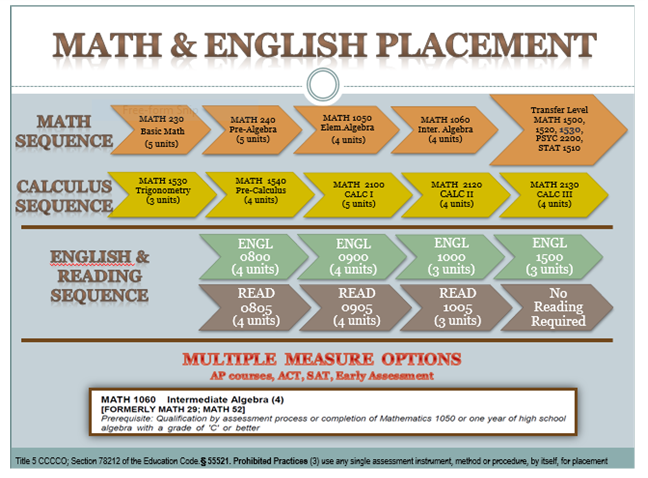
In addition to the specific general education degree requirements listed on the following page, students are required to meet competency requirements in three different areas: reading, written expression, and math.
| 1. |
Reading |
Competency in Reading for Associate Degrees shall be demonstrated by obtaining a satisfactory grade in a reading course at the level of Reading 1005: Practical Reading, or a higher level with a grade of "C" or better; or placement in English 1500 or a satisfactory reading score on the basis of placement testing. |
|
|
|
|
Completed |
| 2. |
Written Expression |
Competency in Written Expression for Associate Degrees shall be demonstrated by obtaining a satisfactory grade in English at the level of English 1500: Composition and reading or a higher level with a grade of “C” or better |
|
|
|
|
Completed |
| 3. |
Mathematics |
Competency in Mathematics requirements for Associate Degrees shall be demonstrated by obtaining a satisfactory grade in a mathematics course at the level of Math 1060: Intermediate Algebra, or a higher level with a grade of “C” or better; or placement in transfer level mathematics on the basis of placement testing. |
|
|
|
|
Completed |
A course may be used to satisfy both a competency requirement and another degree requirement.
Course Requirements: ✓ = Course Completed or IP = In Progress
A. Health Education (3 units)
This requirement can be met by completing:
| HLED 1510 | Principles of Healthful Living | 3.00 Credits(s) |
Veterans who have successfully completed basic training and at least one year of military service are exempt (upon providing a copy of DD-214).
B. American History and Institutions (3 units)
This requirement can be met by completing:
| HIST 2231 | History of the U.S. to 1877 | 3.00 Credits(s) |
| HIST 2232 | History of the U.S. since 1877 | 3.00 Credits(s) |
| POSC 1501 | Government | 3.00 Credits(s) |
C. Information Competency (1 unit)
This requirement can be met by completing:
| INCO 1048 | Info Competency & Bibliography | 1.00 Credits(s) |
D. General Education Requirements (18 units – one from each category)
Natural Science (3 units)
Complete a minimum of 3 semester units from the courses below
| ANTH 1501 | Intro to Biological Anthro | 3.00 Credits(s) |
| ASTR 1511 | Intro, to Astronomy & Lab | 4.00 Credits(s) |
| BIOL 1500 | Fundamentals of Biology | 3.00 Credits(s) |
| BIOL 1501 | Fundamentals of Biology Lab | 1.00 Credits(s) |
| BIOL 1510 | Fundamentals of Biology w/ Lab | 4.00 Credits(s) |
| BIOL 1513 | Intro to Environmental Stud | 4.00 Credits(s) |
| BIOL 2201 | Introductory Biology - Cells | 4.00 Credits(s) |
| BIOL 2202 | General Zoology | 5.00 Credits(s) |
| BIOL 2250 | Human Anatomy | 5.00 Credits(s) |
| BIOL 2255 | Human Physiology | 3.00 Credits(s) |
| BIOL 2256 | Human Physiology Laboratory | 2.00 Credits(s) |
| BIOL 2257 | Human Physiology with Lab | 5.00 Credits(s) |
| BIOL 2260 | General Microbiology | 5.00 Credits(s) |
| BIOL 2370 | Basic Nutrition | 3.00 Credits(s) |
| CHEM 1510 | Introductory College Chemistry | 4.00 Credits(s) |
| CHEM 2211 | General Chemistry | 5.00 Credits(s) |
| ENER 1020 | Intro.to the Petroleum Indust | 3.00 Credits(s) |
| ENER 1510 | Introduction to Energy | 3.00Credits(s) |
| ESCI 1520 | Introduction to Earth Science | 4.00 Credits(s) |
| GEOG 1510 | Physical Geography | 3.00 Credits(s) |
| GEOL 1500 | Intro to Geology | 4.00 Credits(s) |
| GEOL 1501 | Historical Geology | 4.00 Credits(s) |
| PHYS 2221 | General Physics (Calculus) | 4.00 Credits(s) |
| PSCI 1520 | Intro. to Physical Science | 4.00 Credits(s) |
| PSYC 2050 | Intro to Biological Psychology | 3.00 Credits(s) |
Social and Behavioral Science (3 units)
Complete a minimum of 3 semester units from the courses below
| ANTH 1512 | Cultural Anthropology | 3.00 Credits(s) |
| ANTH 1524 | Indians of the Southwest | 3.00 Credits(s) |
| BUSN 1500 | Introduction to Business | 3.00 Credits(s) |
| COMM 1510 | Mass Comm. and the Individ. | 3.00 Credits(s) |
| DS 1504 | Cultrl Comp Twrds Disabilities | 3.00 Credits(s) |
| ECON 2120 | Principles of Economics-Micro | 3.00 Credits(s) |
| ECON 2210 | Principles of Economics-Macro | 3.00 Credits(s) |
| GEOG 1520 | Cultural Geography | 3.00 Credits(s) |
| HIST 2202 | Western Civilization to 1600 | 3.00 Credits(s) |
| HIST 2204 | Western Civilization from 1600 | 3.00 Credits(s) |
| HIST 2210 | World Civilization to 1500 | 3.00 Credits(s) |
| HIST 2231 | History of the U.S. to 1877 | 3.00 Credits(s) |
| HIST 2232 | History of the U.S. since 1877 | 3.00 Credits(s) |
| HIST 2270 | California History | 3.00 Credits(s) |
| JRNL 1510 | Mass Comm. and the Individ. | 3.00 Credits(s) |
| POSC 1501 | Government | 3.00 Credits(s) |
| POSC 2005 | Contemporary Political Topics | 3.00 Credits(s) |
| PSYC 1500 | Introduction to Psychology | 3.00 Credits(s) |
| PSYC 2003 | Child Growth and Development | 3.00 Credits(s) |
| PSYC 2030 | Human Sexuality | 3.00 Credits(s) |
| PSYC 2033 | Personal & Social Adjustment | 3.00 Credits(s) |
| PSYC 2038 | Gender Studies | 3.00 Credits(s) |
| PSYC 2080 | Intro to Lifespan Psychology | 3.00 Credits(s) |
| RECR 1510 | Intro to Recreation and Leisur | 3.00 Credits(s) |
| SOC 1510 | Introduction to Sociology | 3.00 Credits(s) |
| SOC 2038 | Gender Studies | 3.00 Credits(s) |
| SOC 2110 | Minority Group Relations | 3.00 Credits(s) |
| SOC 2120 | American Social Problems | 3.00 Credits(s) |
| SOC 2141 | Sociology of Marriage | 3.00 Credits(s) |
COMM 1510, JRNL 1510: May be used to meet either Humanities or Social Science requirements, but credit will be given for only one of the courses in this pair.
Humanities (3 units)
Complete a minimum of 3 semester units from the courses below
| ART 1600 | Basic Design | 3.00 Credits(s) |
| ART 1610 | Advanced Design | 3.00 Credits(s) |
| ART 1620 | Drawing and Composition | 3.00 Credits(s) |
ART 1630
| | |
| ART 1640 | Painting | 3.00 Credits(s) |
| ART 1800 | Introduction to Digital Art | 3.00 Credits(s) |
| ART 1811 | Graphic Design | 3.00 Credits(s) |
| ART 2010 | Intro to Printmaking | 3.00 Credits(s) |
| ARTH 1500 | Art Appreciation | 3.00 Credits(s) |
| ARTH 1510 | Prehist to Renaissance ArtHist | 3.00 Credits(s) |
| ARTH 1520 | Renaissance to Cont Art Hist | 3.00 Credits(s) |
| ARTH 2030 | Survey of Asian Art | 3.00 Credits(s) |
| ARTH 2040 | Srvy African, Oceanic, Am. Art | 3.00 Credits(s) |
| COMM 1510 | Mass Comm. and the Individ. | 3.00 Credits(s) |
| DRAM 1510 | Introduction to Theatre | 3.00 Credits(s) |
| DRAM 1535 | Elementary Acting | 3.00 Credits(s) |
| ENGL 1600 | Crit Think, Lit, & Composition | 4.00 Credits(s) |
| ENGL 1700 | Intro Creative Writing | 3.00 Credits(s) |
| ENGL 1725 | Creative Writing: Poetry | 3.00 Credits(s) |
| ENGL 1750 | Creative Writing: Fiction | 3.00 Credits(s) |
| ENGL 1775 | Creative Writing: Nonfiction | 3.00 Credits(s) |
| ENGL 2100 | American Literature I | 3.00 Credits(s) |
| ENGL 2150 | American Literature II | 3.00 Credits(s) |
| ENGL 2600 | World Literature I | 3.00 Credits(s) |
| ENGL 2650 | World Literature 2 | 3.00 Credits(s) |
| ENGL 2700 | British Lit 1 | 3.00 Credits(s) |
| ENGL 2750 | British Lit 2 | 3.00 Credits(s) |
| HUM 1500 | Introduction to the Humanities | 3.00 Credits(s) |
| HUM 2010 | Introduction to Film Studies | 3.00 Credits(s) |
| JRNL 1510 | Mass Comm. and the Individ. | 3.00 Credits(s) |
| MUSC 1510 | Music Appreciation | 3.00 Credits(s) |
| MUSC 1520 | History of American Jazz | 3.00 Credits(s) |
| PHIL 1501 | Introduction to Philosophy | 3.00 Credits(s) |
| PHIL 1531 | The World's Living Religions | 3.00 Credits(s) |
| SPAN 1601 | Elementary Spanish I | 4.00 Credits(s) |
| SPAN 1602 | Elementary Spanish II | 4.00 Credits(s) |
| SPAN 2001 | Intermediate Spanish III | 5.00 Credits(s) |
| SPAN 2002 | Intermediate Spanish IV | 5.00 Credits(s) |
COMM 1510, JRNL 1510: May be used to meet either Humanities or Social Science requirements, but credit will be given for only one of the courses in this pair.
English Composition (3 units)
Complete a minimum of 3 semester units from the courses below
| ENGL 1500 | Composition and Reading | 3.00 Credits(s) |
| ENGL 1600 | Crit Think, Lit, & Composition | 4.00 Credits(s) |
Communications and Analytical Thinking (3 units)
Complete a minimum of 3 semester units from the courses below
| ART 1850 | Web Site Production | 3.00 Credits(s) |
| BUSN 1510 | Business Communication | 3.00 Credits(s) |
COSC 1850
| | |
| COSC 2000 | Computer Operating Systems | 1.50 Credits(s) |
| COSC 2002 | Computer Operating Systems | 1.50 Credits(s) |
| MATH 1060 | Intermediate Algebra | 4.00 Credits(s) |
| MATH 1500 | Math for a Modern Society | 4.00 Credits(s) |
| MATH 1520 | Finite Mathematics | 3.00 Credits(s) |
| MATH 1530 | Plane Trigonometry | 4.00 Credits(s) |
| MATH 1540 | Precalculus Mathematics | 4.00 Credits(s) |
MATH 1560
| | |
| MATH 2100 | Analytic Geometry & Calculus I | 5.00 Credits(s) |
| PHIL 1520 | Critical Thinking | 3.00 Credits(s) |
| PSYC 2200 | Elem Stats for Behav and SS | 4.00 Credits(s) |
| SPCH 1507 | Group Discussion | 3.00 Credits(s) |
| SPCH 1511 | Fundamentals of Speech | 3.00 Credits(s) |
| STAT 1510 | Elementary Statistics | 5.00 Credits(s) |
General Education Elective (3 units)
Three additional general education units needed to total 18 units may be selected from any of the above categories
Electives (18 units)
Elective courses used to meet the 60-unit degree total must be degree applicable courses.
| Elective | |
| Elective | |
| Elective | |
| Elective | |
| Elective | |
| Elective | |
Additional Requirements
Completion of Associate Degree requirements does not necessarily complete all transfer requirements to a four-year school. (See counselor for information and advice on transfer requirements).
For career majors, all requirements for the major must be met plus electives to total 60 units.
Other Courses Acceptable Toward Graduation
Courses taken during military service courses are credited in accordance with the recommendations of the American Council on Education. A maximum of 20 units for military service may be applied to Associate Degree requirements.
Appropriate extension or correspondence courses taken through accredited post-secondary institutions will be accepted toward fulfilling graduation requirements.
Units in Residence Requirement
Of the 60 units required for graduation, 12 degree applicable units must be completed in residence at Taft College and used towards the degree, before a degree can be granted.
Scholastic Honors
“Scholastic Honors” at graduation are granted to those who meet the Associate Degree requirements and earn a cumulative grade point average of between 3.00 and 3.49. Students who earn a GPA of 3.50 or above will be awarded “Highest Scholastic Honors.”
A minimum of 30 semester units must have been completed at Taft College in order to qualify for either of these awards. Students who earn the highest grade point averages in the transfer and career/technical divisions of instruction will receive scholastic plaques. Students are classified as “transfer” or “career/technical” on the basis of their majors. In order to qualify for either award, a student must have earned a grade point average of 3.0 or higher in at least 30 semester units.
Life membership awards in Phi Theta Kappa, the community college scholastic honor society, are made according to standards prescribed in the constitution governing all PTK chapters in California.
Application for Graduation
Candidates for graduation must initiate the application for graduation, and must meet with a counselor to apply. Students should submit a candidacy for graduation form by the established deadline of the semester in which they plan to complete the requirements. Deadlines can be found on the Taft College web site.
Commencement Exercises
Awards are acknowledged at the May commencement exercises only, and all students receiving degrees or certificates are encouraged to participate. Students must have completed graduation requirements by the May commencement date of each year in order to be eligible for that academic year’s commencement exercise. Students completing work in a summer session will be eligible to participate in the next academic year’s commencement exercise.